
Interpretive Risk: Fixing Brand Perception in Transitions
A company can budget for lawyers, consultants, technology, and the operational demands of a major transition.
But there’s another risk that doesn’t always appear on the spreadsheet.
What happens when the organization knows where it’s going, but the people it needs to reach are still carrying an outdated picture of what it is?
That’s Interpretive Risk.
And during a leadership change, acquisition, strategic pivot, or expansion into new markets, it can become a consequential business problem.
What Is Interpretive Risk for Brand Perception?
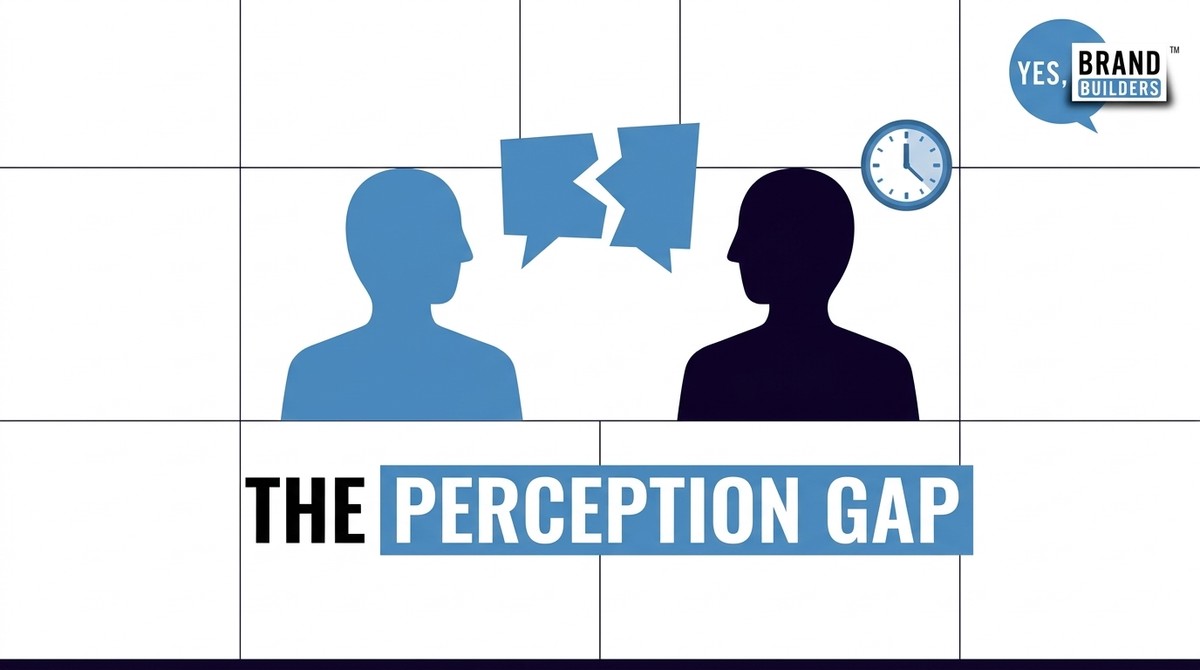
Interpretive Risk is the gap between what an organization intends to communicate and what its audiences actually understand.
A founder may have a clear vision for the next chapter. A leadership team may have spent months developing a strategy. The people inside the organization may understand exactly why a particular decision makes sense.
But customers, employees, partners, and prospective buyers haven’t necessarily been part of those conversations.
They’re working with what they already know.
Sometimes that’s an accurate picture. Sometimes it’s an incomplete one. And sometimes it’s a picture of a business that no longer exists in quite the same form.
I’ve spent much of my career working in branding, publicity, and communications. One thing I’ve learned is that being clear about what you mean doesn’t guarantee that someone else will understand it the same way.
That’s why I describe my work this way:
I listen to your story through the ears of your audience.
The challenge isn’t simply to tell a better story. It’s to understand what the audience is hearing, what they’re missing, and whether that interpretation supports where the business needs to go.
It’s a theme I explore in my book, SELLING THE TRUTH: A ‘Semoir’ with Insights for Life and Business, and one that becomes particularly important when a business is evolving.
When Risk Elevates to Interpretive Jeopardy
Not every misunderstanding is a crisis.
Sometimes someone needs a little more context. Sometimes an explanation clears things up immediately.
But when the gap between what a business intends and what its audiences understand threatens an important objective, Interpretive Risk becomes Interpretive Jeopardy.
Consider a company preparing to enter a new market.
Its leadership understands how much the business has evolved. Its capabilities, experience, and ambitions have changed.
But prospective customers still see the smaller company they remember from several years ago.
That difference in perception could make it harder to win the business the company is now equipped to serve.
Or consider an organization undergoing a leadership transition. Employees may be asking what will change. Customers may be wondering what will remain the same. Partners may be trying to understand the new direction.
Each audience has a different question.
The risk is assuming that one announcement, one message, or one version of the story will answer all of them.
The Moves That Carry the Highest Risk
Interpretive Risk becomes particularly relevant when the business itself is changing.
Here are five situations where I’d pay close attention.
1. A New CEO
A leadership transition raises questions about continuity and change.
What does the new leader intend to preserve? What needs to evolve? How will the organization retain the qualities that made it successful while moving in a new direction?
The answers matter to employees, customers, partners, and other stakeholders, although not necessarily in the same way.
The task isn’t to erase the previous leader’s influence or manufacture a new identity overnight.
It’s to help people understand what the organization is becoming without losing sight of what made it valuable.
2. A Strategic Pivot
A company changes direction for a reason.
Perhaps the market has changed. Perhaps its capabilities have grown. Perhaps leadership sees an opportunity that wasn’t available before.
Inside the business, the logic may be obvious.
Outside it, customers may still associate the company with its previous offerings or position.
That doesn’t mean the audience is wrong. It means their understanding hasn’t caught up.
The strategic challenge is identifying what needs to change in that understanding, and what should remain recognizable.
3. Moving Upmarket
A business may develop the capabilities to serve larger, more sophisticated clients before the market recognizes it as a credible choice.
The company has evolved. Its reputation may not have.
Changing the website, raising prices, or adopting more corporate language won’t necessarily solve that problem.
The question is whether the business can demonstrate its value in terms that make sense to the new audience without abandoning the strengths that got it there.
4. A Merger or Acquisition
When organizations come together, they bring more than systems, products, and personnel.
They bring histories, relationships, reputations, and expectations.
Customers may trust the local business they’ve known for years. Employees may identify strongly with the organization they joined. Leadership may be focused on the opportunities created by the combined company.
Those perspectives need to be understood, not simply overwritten.
The goal is to establish a coherent institutional identity while recognizing what deserves to survive the transition.
5. A Founder’s Growth Plan
Founders live inside their businesses.
They know the origin story, the decisions that shaped the company, and the reasons behind the next move.
Their audiences don’t have that advantage.
As the business expands, the founder’s understanding may be several chapters ahead of what customers, partners, or even employees recognize.
That’s where growth can create a communication problem that is really a strategic one.
What made the business worth caring about in the first place, and how does that value travel into its next chapter?
Importance vs. Urgency: When the Clock Starts
A strategic issue can be important long before it becomes urgent.
A founder may know that the company’s positioning needs to evolve. A leadership team may recognize that its audiences don’t fully understand the business.
But the issue becomes harder to ignore when a consequential event approaches.
A CEO appointment is announced. A new market opens. An acquisition closes. A new offering launches.
Now the organization needs people to understand something specific, and timing matters.
Ideally, the work begins before that moment.
Not because every transition will fail without perfect messaging, but because understanding the gap early gives leadership more room to make thoughtful decisions.
It’s much easier to address a mismatch in perception before it begins interfering with an important business objective.
The Explanation Tax
There’s another cost to Interpretive Risk that doesn’t always show up in a budget.
I call it the Explanation Tax.
You pay it every time someone needs the long version before they can understand what your business does, what makes it different, or why its next chapter matters.
You pay it when a prospective customer sees the company you used to be instead of the one you’ve become.
You pay it when the founder has to personally explain something the organization should be able to communicate without them.
And you pay it when the people responsible for marketing and communications are asked to produce materials before the underlying strategic direction has been fully established.
Some explanation is part of doing business.
But when the same misunderstanding keeps appearing, it’s worth asking whether you’re dealing with an isolated communication problem or something deeper.
Three Questions to Fix Brand Perception
Before a consequential transition, I’d ask three questions.
1. What do we need people to understand?
Not simply what do we want to announce, but what understanding will help the people who matter make sense of where we’re going?
2. What version of us are they carrying?
Are customers, employees, partners, and prospective buyers seeing the business as it exists today? Or are they working from an older or incomplete picture?
3. What happens if that doesn’t change in time?
What business objective becomes harder to achieve if the gap remains?
These questions won’t produce every answer.
But they’ll help establish whether the problem is one of communication execution or whether the organization needs to clarify its strategic direction first.
That’s an important distinction.
Frequently Asked Questions
What is Interpretive Risk?
Interpretive Risk is the gap between what an organization intends to communicate and what its audiences actually understand. It becomes especially relevant when a business evolves faster than the way people perceive it.
When does Interpretive Risk become Interpretive Jeopardy?
When that gap threatens a consequential business objective, such as a leadership transition, expansion, acquisition, or strategic change.
Which business transitions deserve particular attention?
CEO succession, strategic pivots, moving upmarket, mergers and acquisitions, and founder-led growth are five situations where different audiences may need to understand a changing organization in different ways.
How can leaders reduce Interpretive Risk?
Start by identifying what audiences currently understand, what they need to understand, and the business consequences of the gap. Then establish a strategic direction that communications and marketing can support.
What is the Explanation Tax?
The Explanation Tax is the recurring cost of having to clarify what your business has become, why it’s different, or why it matters because the audience is working from an incomplete or outdated understanding.
Find the Gap Before It Gets in the Way
Businesses evolve. Leaders change. Markets expand.
The challenge is making sure the people who matter can recognize the business you’re becoming.
That’s where my work begins.
The Authority Sensor diagnostic is designed to identify where your intended message and your audience’s understanding may be out of alignment.
[Book an Authority Sensor diagnostic] to explore where the friction may be occurring.