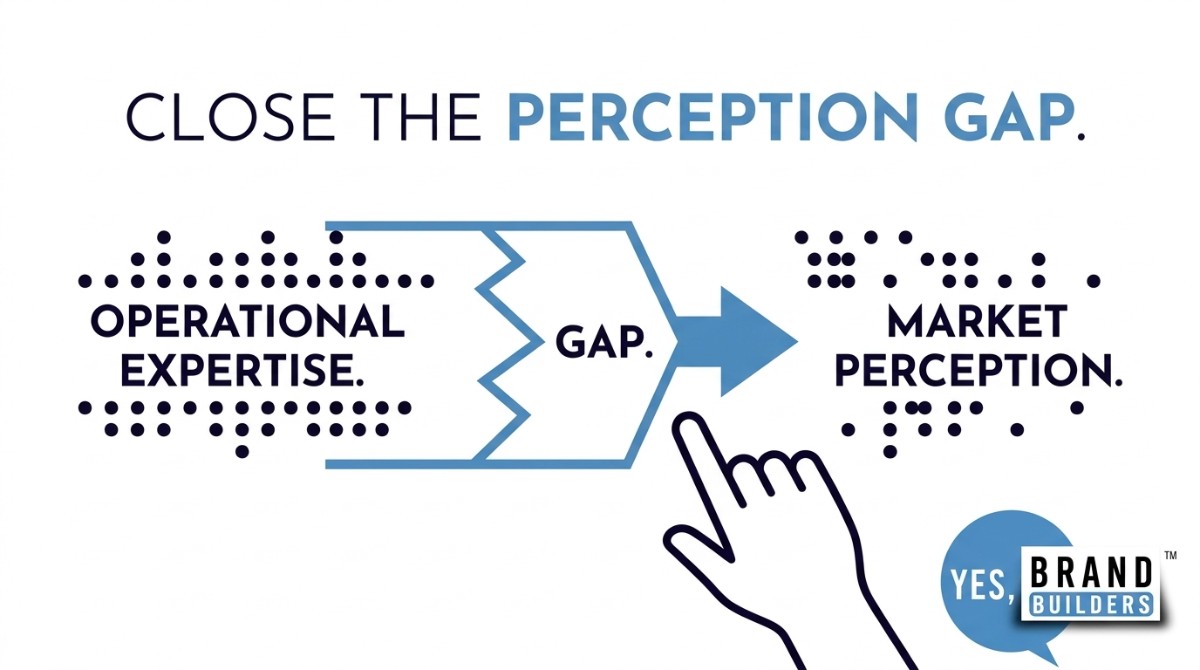
What happens when the market still sees the company you used to be?
There’s a particular challenge that comes with building a successful business.
People get to know you.
They understand what you do, what you’re good at, and where you fit.
And then you go and change things.
Maybe you’ve expanded into a new market. Developed capabilities your original customers never imagined. Built a team that can accomplish things you couldn’t do alone. Or started thinking about what the business could become beyond your own involvement.
The business has evolved.
But the people encountering it for the first time may still be seeing an earlier version.
And sometimes the people who know you best are the slowest to recognize what’s changed.
The problem with being understood too quickly
I’ve spent a lot of time looking at what happens in the first moments someone encounters a person or business.
One of the most interesting problems isn’t that people don’t understand what they’re seeing.
It’s that they think they do.
They recognize something familiar, assign it a category, and move on.
I call this interpretive compression.
A founder building a sophisticated enterprise is still seen as a consultant.
A company developing an entirely new capability is understood as another service provider.
An established business entering a new chapter is evaluated according to what it used to be.
None of these interpretations has to be entirely wrong to become expensive.
They only have to be incomplete enough to influence the decisions people make.
Which conversations you get invited into.
What opportunities you’re considered for.
How much confidence a prospective partner has in what you’re building.
And whether someone sees you as the person who can execute an assignment or the person who belongs in the room when the assignment is being defined.
More visibility won’t necessarily solve it
When a business isn’t attracting the opportunities its founder believes it should, the natural response is often to do more marketing.
More content. More outreach. More PR. More visibility.
Those things can be valuable.
But they don’t necessarily change what people think they’re seeing.
If your audience has an incomplete understanding of your business, increasing your visibility may simply introduce that incomplete understanding to more people.
That’s why I believe strategic decisions about identity, positioning, and meaning need to precede decisions about amplification.
Before asking how to reach more people, ask whether the people you’re already reaching understand what you’re becoming.
There’s another identity in the room
For founders, this gets especially interesting because there are often two identities evolving at once.
The founder’s.
And the company’s.
Early in a business, the distinction may hardly matter. The founder is the business’s voice, reputation, relationships, and driving force.
But as the organization grows, the relationship changes.
The founder may want to become more visible as a thinker, industry leader, or strategic voice.
Meanwhile, the company needs an identity and reputation that can function without the founder explaining everything personally.
Those two identities should strengthen each other.
But that doesn’t happen automatically.
A founder’s growing authority can create opportunities the company isn’t positioned to capture.
And an organization’s growth can create capabilities and ambitions that its founder’s existing reputation doesn’t fully represent.
The question becomes larger than messaging.
What does the founder need to mean? What does the institution need to mean? And how do those meanings work together?
Los Angeles is a particularly interesting place to have this conversation
Los Angeles has long been a place where people build businesses around creativity, relationships, intellectual property, and personal reputation.
It’s also a place where businesses can evolve far beyond the category in which they first became known.
That makes the relationship between founder identity and institutional identity especially worth examining.
Not because every founder has a positioning problem.
But because growth creates new questions that earlier success doesn’t necessarily answer.
What are we becoming?
What do people still believe we are?
And what opportunities might we be missing because those two things no longer match?
These are the conversations I’m increasingly interested in having with founders and business leaders.
Not conversations about how to make more noise.
Conversations about whether the signal is still telling the truth.
Because when your business changes, the market’s understanding of it doesn’t necessarily change with you.
And the cost of that difference can be substantial.