You don’t know your positioning is working because people understand it.
You know because they behave differently.
One of the easiest mistakes to make is confusing recognition with progress.
People understand you.
Great.
What happened next?
Because the proof isn’t in the understanding.
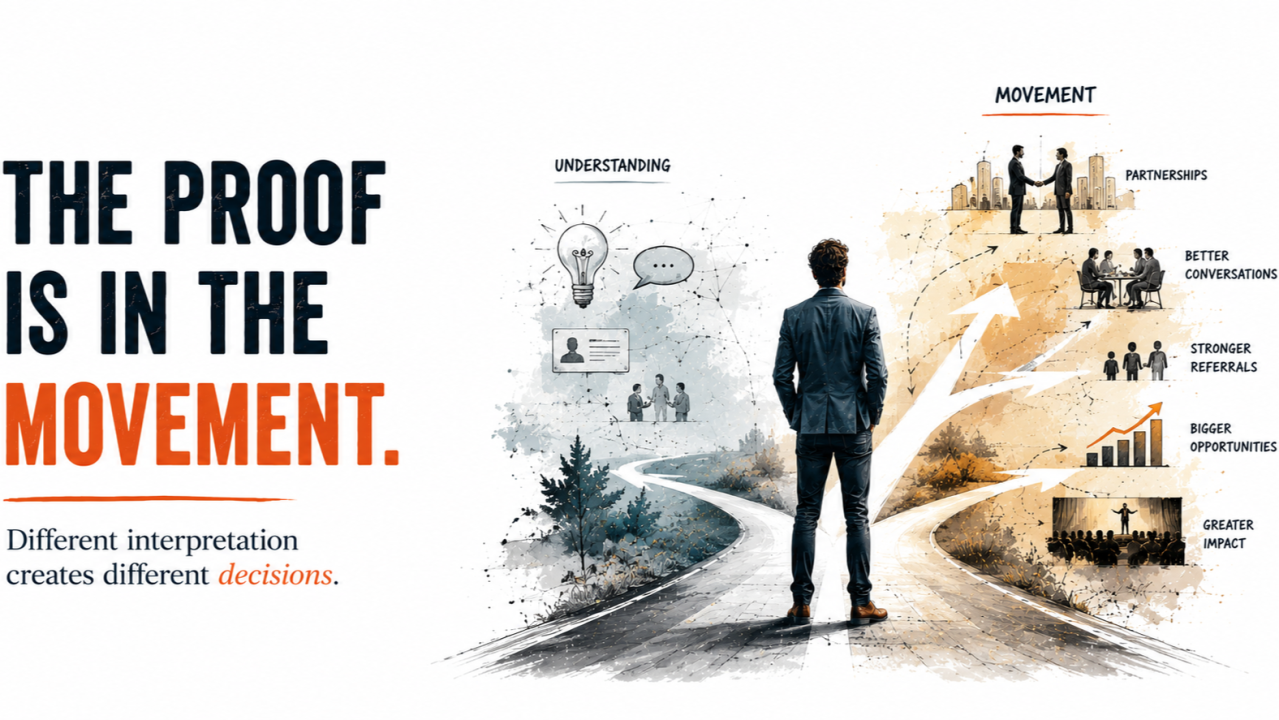
The proof is in the movement.
I’ve spent a lot of time lately thinking about the gap between recognition and action.
It’s surprisingly large.
Someone can understand exactly what you do and never hire you.
Never refer you.
Never introduce you.
Never think of you when the right opportunity appears.
In other words, they can understand you perfectly and still do nothing.
That’s why I’ve become increasingly skeptical of clarity as the primary metric.
Clarity matters.
But clarity is not the finish line.
It’s the beginning.
The real question is what happens next.
Do the conversations change?
Do the opportunities change?
Do the referrals change?
Do people begin seeing you differently?
Do they make different decisions because of what they now understand?
Recently, I was talking with someone in the middle of a repositioning effort.
I asked what she was seeing.
Her answer wasn’t:
“People understand my message better.”
Her answer was:
“We’re having more qualified conversations.”
“People are seeing the value of the bigger offer.”
“Ultimately, we’re attracting larger projects.”
That’s movement.
The message didn’t just become clearer.
The market began behaving differently. That’s the tell.
Not applause.
Not engagement.
Not compliments.
Behavior.
The market is constantly telling us what it thinks we’re worth.
Not through surveys.
Through decisions.
Who contacts us.
Who refers us.
What they ask for.
What they assume.
What they overlook.
The challenge is that many professionals stop measuring after recognition.
Someone says:
“That really resonates.”
And they treat that as a win.
Maybe it is.
Maybe it isn’t.
The more interesting question is:
What happened after it resonated?
Did the opportunity get larger?
Did the conversation get deeper?
Did the buyer arrive more prepared?
Did the market begin assigning greater value?
Those are harder questions.
They’re also the ones that matter.
Because interpretation isn’t a communication problem.
It’s a business problem.
And the proof that interpretation changed is never found in what people say.
It’s found in what they do.
If the conversations are different, the interpretation changed.
If the opportunities are different, the interpretation changed.
If the decisions are different, the interpretation changed.
Everything else is commentary.
The next time someone tells you your message is clear, resist the urge to celebrate immediately.
Instead, ask:
What changed because they understood it?
That’s where the real answer lives.