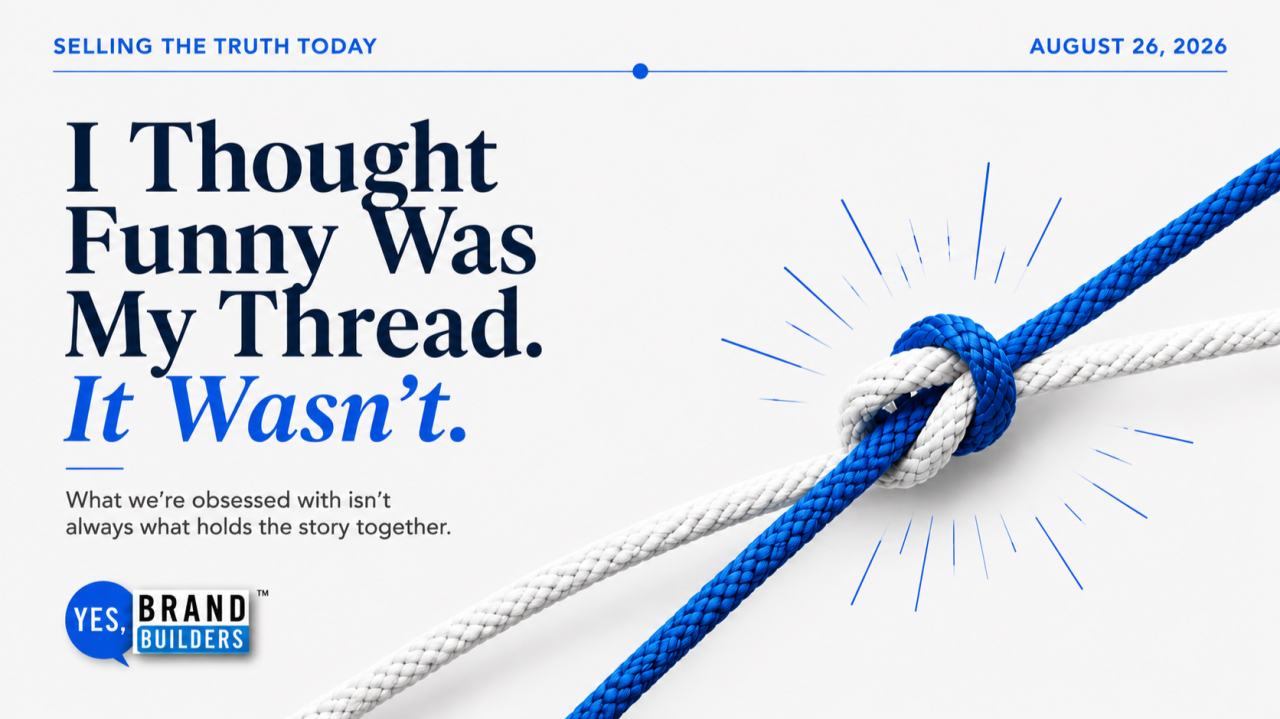
What we’re obsessed with isn’t always what holds the story together.
Funny, in all its forms, has fascinated me for as long as I can remember.
Making people laugh. Finding the unexpected angle. Understanding why one word works where another doesn’t. Using humor to get through the front door of an idea that might otherwise stay closed.
There was plenty of evidence.
I’ve written comedy, performed it, studied it, interviewed comedians and spent an unreasonable amount of time thinking about why something makes us laugh.
For a significant stretch of my life, standup comedy was an obsession.
Today, humor is a tool of my trade.
An important one. Humor can create connection, disarm, make something memorable or help us see an old problem differently.
Other times, it isn’t needed.
And sometimes it’s positively ill-advised.
Which led me to a useful realization:
If I can put the tool down and the essential nature of my work remains, the tool isn’t the thread.
The obsession may be evidence
On Monday, I wrote in COHERENT about paying closer attention to the things that have fascinated us for years.
I still believe those obsessions matter.
But we need to be careful about what we make of them.
The obsession may be where you notice the thread. It isn’t necessarily the thread itself.
Standup wasn’t mine.
Neither was entertaining. Neither was advertising, PR, writing, podcasting or branding.
I’ve spent significant parts of my career doing all of them. They’ve shaped me, and many remain part of how I work.
But none explains the whole picture.
So I’ve become more interested in a different question:
What was I actually doing in all of those things?
Not what did I sell?
Not what was my title?
Not what industry was I in?
What did I repeatedly bring to the situation that was distinctly mine?
That’s where the thread starts becoming visible.
What survives when the labels come off?
After a few decades of work, we accumulate a lot of nouns.
Founder. Writer. CEO. Consultant. Speaker. Advisor.
They’re useful shorthand. But when we’re figuring out what comes next, they can also keep us looking backward.
We start building the future out of the nouns we’ve accumulated in the past.
I was a CEO, so perhaps I should advise CEOs.
I built companies, so perhaps I should build another.
I’ve been fascinated by something for 30 years, so perhaps that’s my next chapter.
Maybe.
But a thread has a bigger job.
It has to make sense of what came before without trapping us there.
It should survive when a title disappears or a favorite tool gets put down.
And it has to be useful now.
Because I’m not particularly interested in finding a clever sentence that explains the last 30 years.
I’m interested in identifying the through line that makes the next ten or fifteen coherent.
That’s the 360-degree view.
Not every job, accomplishment, fascination or tool.
The coherent picture they create when viewed together.
The ability to look at all of it and say:
This is what it adds up to now.
The thread isn’t asking you to throw anything away
Finding the thread doesn’t require us to choose between everything we’ve been and whatever we’re becoming.
We get to carry forward what still belongs.
Put down what doesn’t.
And let some things serve us differently.
Standup comedy was once an obsession of mine.
Humor is now part of how I communicate, write, interview, advise and connect.
It’s still important to me.
But I don’t need it to explain who I am.
The thread goes deeper.
And yours probably does, too.
If the pieces of your experience make sense individually, but you’re having a harder time seeing what holds them together now, my Authority Sensor can help diagnose where interpretation is getting tripped up—and whether the thread underneath it is hiding.
It’s a focused conversation about your signal, your authority and the thread connecting what you’ve done with what you’re becoming.
Bring the experience.
Bring the obsessions.
Bring the pieces that don’t seem to fit.
That’s what the Sensor is for. Not to tell you your thread. To diagnose where interpretation is getting tripped up — and whether the real thread is hiding underneath it.