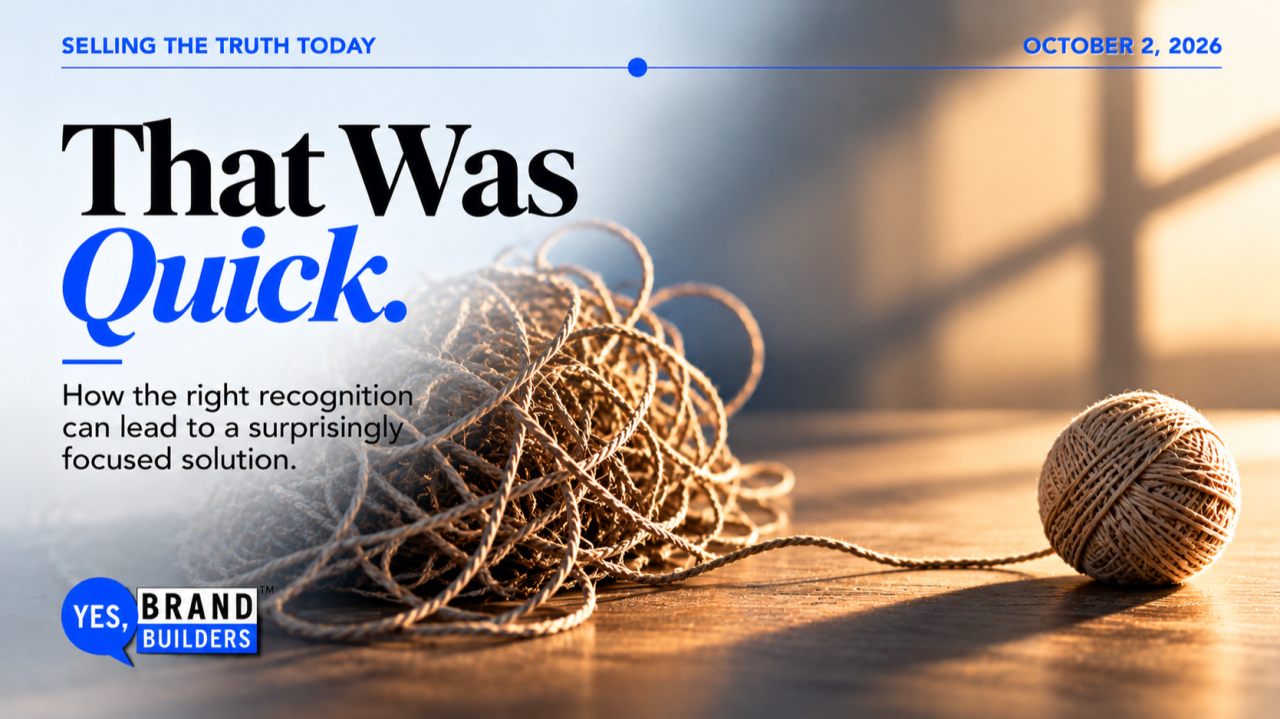
A strange thing happens when you get good at something.
It starts taking less time.
This is generally considered a feature.
Nobody complains when the mechanic finds the problem in ten minutes instead of keeping the car for three days.
But there are kinds of work where speed can feel suspicious.
Strategy is one of them.
I can be talking with someone about their business, their career or whatever consequential thing is changing around them and sometimes see the central problem surprisingly quickly.
Not the entire answer.
The thing underneath the stuff.
And there are moments when the speed of that recognition feels almost inappropriate.
This matters too much to have figured it out already.
Except sometimes we have.
A client came to me because she had some important professional conversations coming up.
Accomplished executive. Long career. Serious responsibilities. Plenty of evidence.
It would have been perfectly reasonable to work on how she should present herself.
Except fairly early in the conversation, it became clear that presentation wasn’t really the problem.
Her career had produced a kind of judgment that her titles could no longer adequately describe.
So the work changed.
We stopped preparing her to explain where she’d been and started establishing how people should understand the executive she had become.
Another client was the founder of a successful professional services firm who was becoming increasingly drawn to speaking, teaching and a larger public role.
The business was good. Her reputation was good. Her expertise was unquestioned.
Then she said one sentence about what she actually wanted for the people she served.
There it was.
The expertise everybody associated with her wasn’t the destination.
It was the vehicle.
That changed what she should carry publicly, what the firm should carry, and how the two could strengthen one another.
One sentence.
Pretty consequential sentence.
Then there was a client who arrived with a book, decades of industry experience, intellectual property she’d developed years earlier, professional education, consumer education, speaking ambitions and a desire to influence her industry.
Lots of pieces.
It would have been very easy to spend months organizing the pieces.
Instead, a principle she had been working with for more than twenty years emerged as the thing connecting them.
Suddenly the book wasn’t the project.
It was one expression of a much larger body of work.
A recent client described what this kind of work felt like from his side:
“The name that you came up with, ‘Global Info Worker,’ really helped transform my approach to the work and gave me some confidence. Putting together the whole brand voice made me realize, ‘Well, you know what? I am doing something here.’
Thomas Schueneman Global Info Worker | Science Communicator & Audio Producer
A big transformation.
That’s the part that interests me.
None of these people had simple problems.
We tend to assume consequential problems require complicated processes.
Sometimes they do.
Sometimes the complexity is precisely why an experienced outside perspective can see the organizing problem faster.
And once you can see it, the work can become remarkably focused.
A few days on the inside.
A few weeks sometimes.
Maybe a month.
That can feel weird.
Should work capable of affecting a founder’s role, a company’s identity, a career, a book, a market position or the next several years of decisions really happen that quickly?
Apparently, yes.
Because time and consequence aren’t the same unit of measurement.
The hour isn’t necessarily the measure of the work.
It’s where years of pattern recognition get concentrated.
That doesn’t mean rushing.
There is still work after recognition.
You test what you saw.
Trace where it shows up.
Understand what changes if you get it right.
Establish what must remain true.
Then make that understanding usable.
What I’m increasingly unwilling to do is make the work take longer because longer would make it feel more consequential.
The client doesn’t benefit from my taking six weeks to see something I could see in an hour.
They benefit if I see the right thing.
And if what we do with it keeps working after I’m gone.
Maybe that’s one of the stranger effects of expertise.
The work doesn’t necessarily get bigger.
It gets more concentrated.
And sometimes a surprisingly small container can hold a very big change.
SELLING THE TRUTH
A consequential problem does not owe us a complicated solution.
Sometimes the value of experience is recognizing what matters before everybody spends another six months working around it.
TIP OF THE DAY
If experience allows you to solve something faster, don’t add ceremony to make the work feel substantial.
Make sure you saw the right thing.
Then make what you saw useful.
If something consequential has changed in your work, but the way people understand it hasn’t caught up yet, that’s work I do.