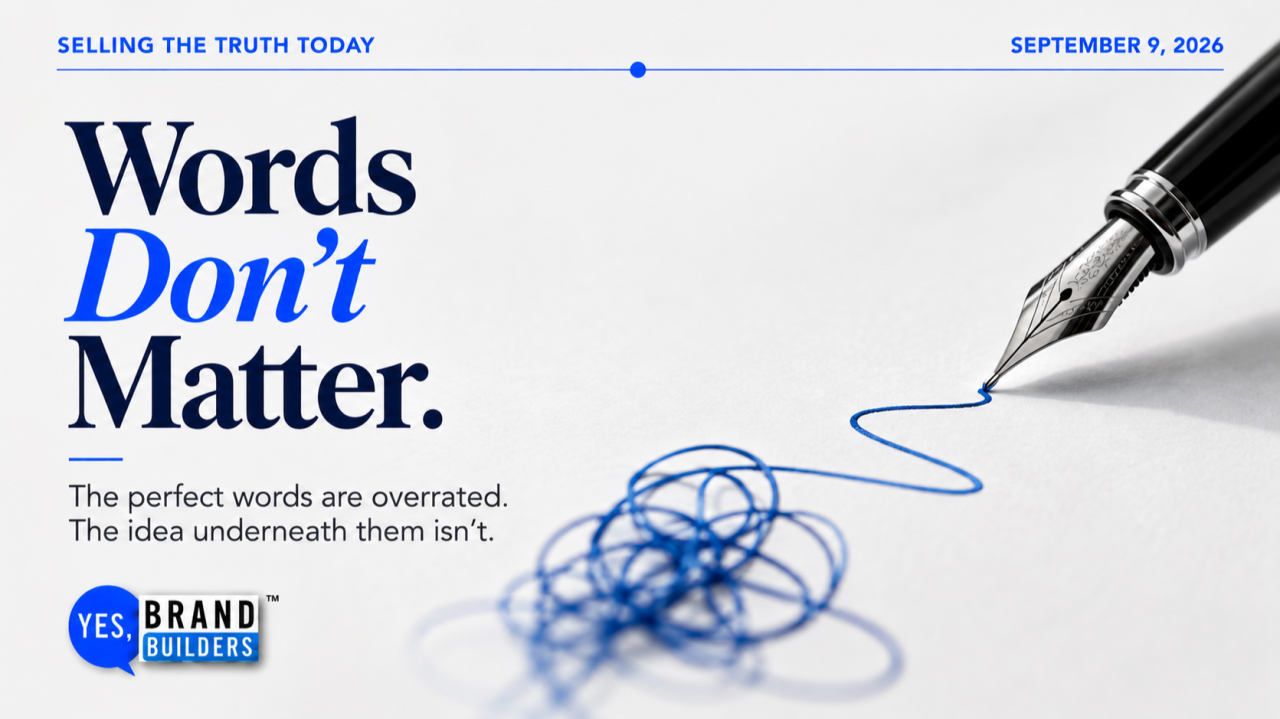
The perfect words are overrated. The idea underneath them isn’t.
I’ve been a copywriter forever.
It’s part of my DNA.
I’ve spent a ridiculous percentage of my life looking for exactly the right words. The headline, the tagline, the mission statement, the elevator pitch, that magical 30-second combination that perfectly conveys who you are, what you do and why it matters, and ideally causes the person standing next to you at a cocktail party to say, “Wow, that’s cool. Tell me more.”
We’ve all done it. Someone asks, “So, what do you do?” and in the back of your brain, the teleprompter starts scrolling.
Except I don’t think that’s how it works anymore.
In fact, I’ve come to believe something mildly heretical for a lifelong copywriter:
Words don’t matter.
At least, not the way I thought they did.
If we were in a room together, I could prove it.
Ask me what I do.
“I work with interesting people who are tired of explaining themselves.”
Now somebody else ask me.
“I help businesses that have evolved beyond their perception in the marketplace.”
Somebody else.
“I find the thread that runs through a founder’s career so they can stop paying the explanation tax.”
Again.
“My work sits upstream of PR, marketing and amplification.”
One more.
“I help accomplished people make what they’re becoming easier to understand.”
I could keep going. I haven’t given you the same answer twice, and none of those answers is the answer.
Liberating, isn’t it?
For years, I thought the goal was to find the words. Now I think the goal is to understand the idea well enough that you don’t have to depend on them.
That’s what I mean by Conceptual Copywriting.
It’s not a collection of approved phrases or a beautifully polished elevator pitch everyone is supposed to memorize. And it’s definitely not asking AI to produce a Brand Voice Guide in two minutes that informs you your brand is “confident but approachable, authoritative but conversational.”
Which apparently describes every company on Earth now.
Conceptual Copywriting starts with strategy. It means understanding what you actually believe, the thread running through your work, what you’re becoming, the distinctions you make that matter, and what your audience needs to understand.
Once you have that, the language becomes much more flexible.
Your CEO doesn’t have to sound like your marketing director. Your salesperson doesn’t have to recite the website. The person being interviewed on a podcast doesn’t need to remember what was written in the Brand Voice Guide six months ago.
They need to understand the ideas.
And increasingly, so does your AI.
I don’t want my AI memorizing my copy. I want it understanding my strategy well enough to help me express that strategy differently depending on the audience, the moment and what I’m trying to accomplish.
Which, incidentally, is exactly what’s happening here.
This article didn’t begin with me staring at a blank screen looking for words. It came out of months of work on my own positioning, conversations with clients, experiments with AI, things I noticed that didn’t quite fit together, and one simple idea that kept getting stronger as I tested it:
Words have become abundant. Understanding has not.
Then I brought that understanding into my generative AI tools. Not so they could tell me what I think, but so I could interrogate the idea, connect it to other things I’ve been working on, argue with it, refine it and eventually turn it into what you’re reading now.
And, somewhere along the way, it became the basis for a keynote I’m developing.
That feels significant to me because I’ve spent most of my professional life believing that my value was in finding the words.
Increasingly, I think the value was in the understanding that produced them.
The words were evidence.
That changes the way I think about copywriting. It changes the way I think about brand voice. And it definitely changes the way I think about using AI.
Because if you know what you mean, you don’t have to spend the rest of your life searching for the one perfect way to say it.
You can just talk.
So let’s do some Conceptual Copywriting together.
And the words will just come.
Where to start? Book your 1:1 Authority Sensor with me.